
In my lockdown isolation in northern Italy, against the devastating backdrop of COVID-19, I took some time off to sit down and revisit the frameworks I have been teaching my MBA and executive students for a couple of decades. How come? Well, in a world facing growing inequality, the dominance of a few major platforms, ineffective economic policy and regulation, the exhaustion of natural resources, social unrest, and the unprecedented economic impact of the pandemic, I became increasingly convinced that our economic system was broken and no longer fit for purpose. Despite any benign intentions, it had become an entrenched framework that made it possible for a few opportunistic, well-informed actors – best illustrated by the Big Tech companies and their platforms – to game the system at the expense of the well-being and prosperity of everyone else, with dire consequences for our planet and our society. I wanted to think about how business school professors like me could train future leaders to build a global economy that better served the needs of our society and the generations to come. This led to further reflections about what that economy should look like and how it would function. Research tells us that most people are, by nature, prosocial rather than opportunistic, so how did we get to the point where our economic system so heavily favors the opportunism of a few over cooperation in communities and our society at large? After a period of exploration, my prognosis was rather pessimistic for those who believe we just need to tweak or amend our existing economic system to fix things. In my book, The Cooperative Economy, I identify five grand challenges the current economic system has enabled and explain why that system cannot be reformed. In this article, I explore those five challenges and propose a vision for a new, platform-based economic system. I discuss how this system might work in practice and how we could address any pitfalls in its execution. To read the article visit I by IMD Issue 13 article
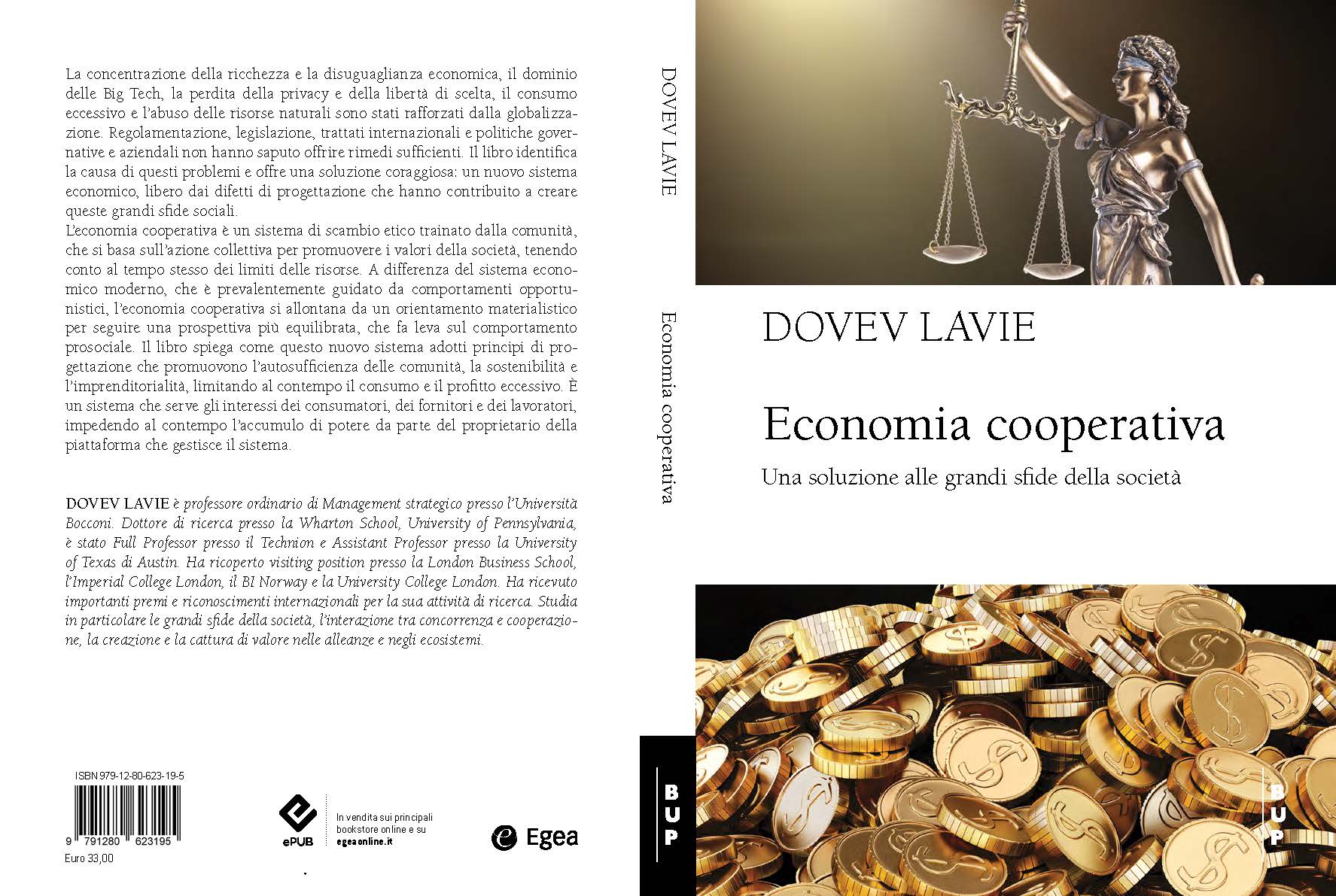
I am thrilled to announce that the Italian translation of my book “Economia Cooperativa” is now available for purchase here. The book has an updated preface and fine Italian style! The book is published by Bocconi University Press (EGEA) which invested much in the translation to ensure its accuracy and coherence.
A webinar introducing the book will be held live on YouTube on March 25 at 17:30 Italy time. Joining me in this event are Carlo Salvato from Bocconi University who will moderate the discussion and Tommaso Valletti from Imperial College London who will discuss the challenges imposed by the Big Tech firms and the shortcomings of regulation as a backdrop to my discussion. My book offers a possible solution to these challenges in the form of a digital platform that leverages design principles to promote prosocial behavior. The webinar will be held in Italian with the exception of my part which will be held in English (I wish I could do this in Italian). Here is the link to the webinar. Grazie!

Readers of my book were invited to take part in a simple experiment. The $5 experiment examines a core idea of the cooperative economy – that of prosocial behavior. Would individuals be willing to promote the welfare of others at a cost to oneself? The experiment was designed to reveal if participants feel happier giving or rather receiving money.
The experiment was framed as following:
“Find a homeless person or a beggar in your neighborhood or town, and to the extent that you believe that this individual is truly in need, give them five dollars or the equivalent in your local currency. Once you have done so, proceed and meet a colleague or a friend and ask them to give you the same amount of money.”
Based on the 55 anonymous responses thus far, 93% reported feeling happier giving money with only 7% reporting being happier receiving money (see chart).
Of course, there could be a selection bias here because most of those who showed interest in taking part in this experiment are readers of my book who identify the problems with our current economic system and recognize the need for revisiting the principles of economic exchange. They are more likely to be prosocial.
For that reason, it is useful to consider the results of other experiments using randomized samples. For example, Flynn, Ehrenreich, Beron, & Underwood reported in their 2015 study of prosocial behavior in the Review of Social Development, that about 30% of the participants revealed a high inclination for prosocial behavior, 53% showed a medium level and the remaining participants exhibiting low levels of that inclination (see chart).
The fact that most of the population has medium-to-high inclination for prosocial behavior gives hope that by redesigning the economic system we can expect such prosocial behavior to overpower opportunistic behavior.
To learn more about my proposed design, visit www.cooperativeeconomy.net
If you wish to participate in the $5 experiment, you can complete it on my book’s website: https://cooperativeeconomy.net/5-experiment/

The cooperative economy offers a solution to societal grand challenges: economic inequality, dominance of platform ecosystems, overconsumption of resources, loss of privacy and free choice, and drawbacks of globalization. It dismantles the caveats of the modern economic system. Instead of applying a band-aid to treat this bleeding system, it reengineers its DNA, replacing its greed-driven motive with a counter-logic of prosocial behavior. To accomplish this, it must be a grassroots initiative for the community and by the community, supported by individuals who identify with its mission.
The cooperative economy can be contrasted with alternative approaches for revising our economic system. Some expect corporations that have benefited the most from capitalism to promote societal values. Others call for transferring ownership of assets to society in pursuit of democratic socialism. Such approaches are neither practical nor sufficient. The cooperative economy expects communities rather than firms to take the lead and proposes a shift in mindset rather than a change of governance form. It departs from established approaches that have taken utility and profit maximization for granted.
My theoretical ideas may seem progressive or utopian but are in fact pragmatic. I elaborate on the economic model and offer a practical plan for its implementation. I call on my fellow researchers to join in refining and perfecting the system. I extend a call to private financiers who wish to see a return to society to donate and fund such research. I reach out to software engineers, programmers, and algorithm experts who wish to make a difference in this world, please leave your details on the book’s website. Together, we can make this idea a reality that can change the world for the better.
My book, The Cooperative Economy, is available from Routledge or Amazon. For more information visit www.cooperativeeconomy.net